Click Here to Play Letter Boxed Game
How to Play Letter Boxed: Complete Guide for Beginners
If you’ve yet to play Letter Boxed for the first time ever, this page will help you tackle your very first board. Think of it less as a manual, and more as a tutorial. After a few completed boards, you’ll want to reference our fully-detailed Rules page, which dives deep into the many edge cases presented in this game. This guide is all about ease of entry and victory in your first puzzle of today.
When you first open the game, you’ll see a square with twelve letters around it, with three letters per side. This square comprises the entire puzzle- nothing more, nothing less. You’re only tasked with one thing, and it’s impossibly rewarding to accomplish: make words with these twelve letters until you’ve used every one at least once.
The puzzle was made by Sam Ezersky and debuted in the NYT Games section in 2019, joining Wordle , Spelling Bee , and Connections as other popular puzzles made by The New York Times. If you know any of the aforementioned already, you’ll have little trouble with the vocabulary aspect of Letter Boxed; the difference is in the building of words, not their contents.
Your First Move
It’s entirely up to you where you begin. Pick any letter you want, and there’s no ‘right’ or ‘wrong’ answer for your opening choice (though later in this guide, we’ll talk about which openings are stronger than others).
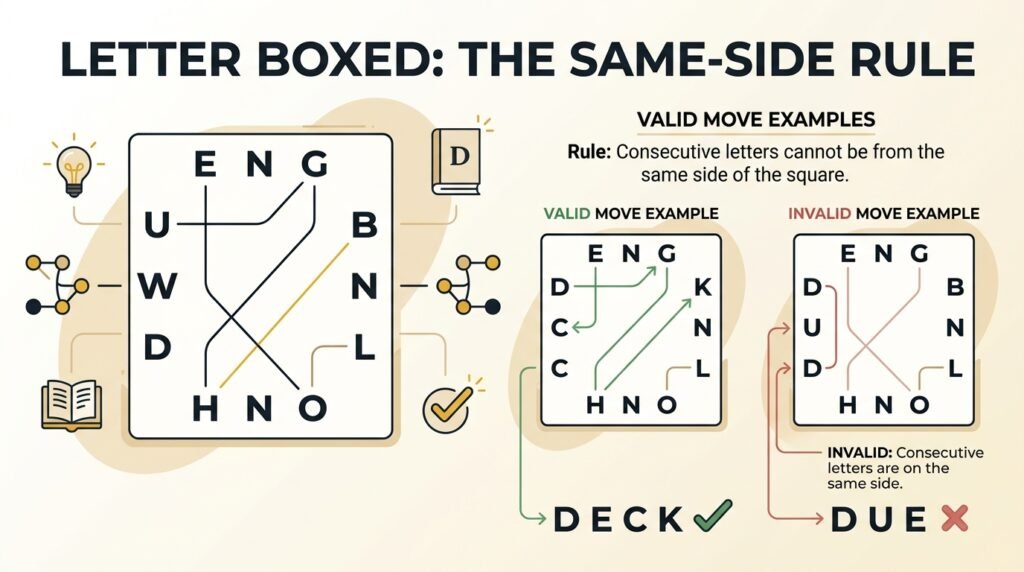
After choosing your starting letter, continue tapping letters to form your first word. There’s only one rule that might surprise you, and it’s easy to overlook at first: you can’t use two letters in a row that came from the same side of the square. If you used a letter on the top side of your box for the first letter in your word, the next letter in your word can’t come from the top, either, even if there’s a second letter on the top that you haven’t used yet.
This restriction is what makes the game different from a standard word search. You aren’t just finding words that are already there, but must plan out your path around the square as you go.
End Your First Word
Your first word can be any length, but must be at least three letters. When you’re happy with it, you can tap Submit to finish it. If it’s a valid word according to the rules above, it will appear on the square as a word with all of its letters used up.
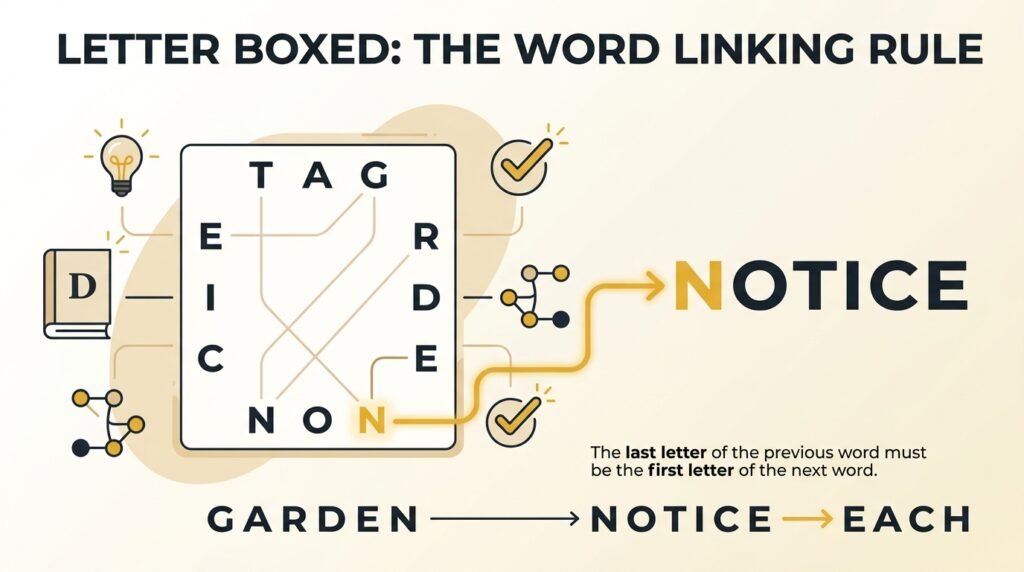
Notice that the word GARDEN ends in an N.
Begin Your Second Word
Now it gets interesting, because here’s the second crucial rule: every word after the first has to begin with the letter that the previous word ended with. This means that your second word has to begin with an N , since your first word, GARDEN , ended with one. So you could easily follow that up with a NOTICE .
This linking of words is what makes it feel like you’re constructing one long word rather than several smaller words. If you forget this rule and try to enter a word that begins with a different letter, you’ll get a helpful error, but it’ll definitely throw you off when it happens, especially early on.
Winning the Puzzle
Continue linking your words together until you’ve used up every single letter on the board. That’s it; that’s all it takes to win. There’s no time limit, and there’s no score beyond how few words you used. It’s all about efficiency, really.
The fewer words it takes you to finish a puzzle, the better the result. A two-word solve is considered a genius solve and is the ideal victory. Most people will manage a solid, average solve in three to five words, and anything above that still counts as a win, just not as impressive.
A Full Example
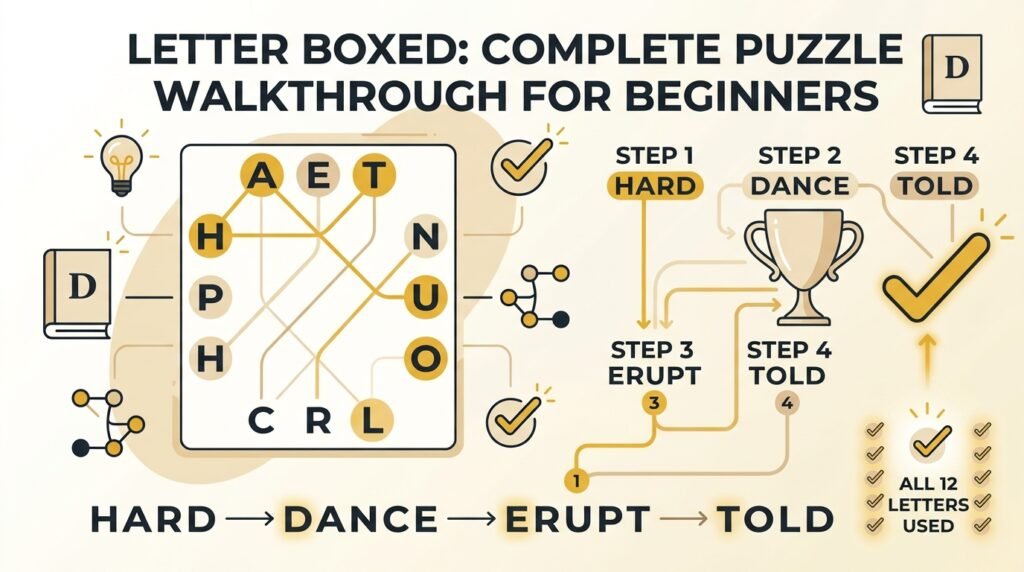
Let’s try working through an entire puzzle together. We’ll use the example provided in the image above.
- Top: A, E, T
- Right: N, U, O
- Bottom: C, R, L
- Left: D, P, H
1. First word: HARD
HARD has four letters, none of which are on the same side as the one that came before it (remember, we haven’t used any letters yet, so there’s nothing to compare it to). This is a solid opening, as we’ll discuss later. HARD uses a letter from the left, top, bottom, then left again.
2. Second word: DANCE
We have to start this word with the letter D, since that’s what HARD ended with, and we do! DANCE begins on the left, moves to the top, then to the right, bottom, and top again. None of these letters are on the same side as the one before it, and we get to check off three new letters as used!
3. Third word: ERUPT
ERUPT begins with E, which is the last letter of DANCE, so it fits the linking requirement. It goes to R on the bottom, then U on the right, P on the left, and T on the top, getting us two more letters.
4. Fourth word: TOLD
TOLD begins with T, which is the last letter of ERUPT. It goes to O on the right, L on the bottom, and D on the left, using up the remaining two letters. When we check off all of the letters used, we’ll find that we’ve used all twelve letters on the board, and we’ve done it in four words, a pretty good solve for a first-timer!
Hints for Your First Puzzle
Don’t try to get a two word victory on your first few puzzles, if you can help it. It’s easy to fall in love with the idea of a genius solve right off the bat, but you’ll waste a lot of your time barking up the wrong tree if you’re not familiar with the board yet. Getting a confident four- or five-word solve after learning the game is much more satisfying than a failed hunt for a two-word solve.
Watch where you end your words. Whatever letter you end on will decide what letters you can use next, so try to save letters that you know you’ll be able to use for your next word. As a beginner, you want to end on common letters like E, R, S, or T if you can, but avoid rare letters like Q, X, and Z if you can.
If a word gets rejected and you know it’s spelled correctly, make sure that two consecutive letters didn’t come from the same side and that the word actually began with the letter that the previous word ended with. These two mistakes are the most common ones for new players, and they’re also the easiest to fix.
Don’t get hung up on using long, fancy words. Short words can be just as useful as long ones, especially if you want to end on a good letter.
What Happens When You Win
When you finish off the last unused letter, the board marks itself as complete and displays your score, showing how many words it took you and how that compares to a perfect, two-word solve. From there, you can simply refresh the page again to begin another puzzle. There’s no daily limit here, so you can play as many boards as you’d like in a row, at any difficulty.
Choosing the Difficulty
Beginners are best advised to start on Easy, where you have a bigger pool of acceptable words to choose from. When you can consistently complete Medium puzzles and know the same side rule and linking rule intuitively, you’re ready to move on to Hard. Harder boards use trickier combinations of letters and often include rare letters that you have to work around to complete the puzzle.
What’s Next?
After you’ve mastered the basics, the Rules page goes into much greater detail about the specifics of the game, including what kind of words get rejected and why. Our Strategy guide builds upon what you already know, giving you more advice for bridge letters, vowels, and even solving two-word puzzles when you’re ready to move on from simply learning the rules.