Word Box.
Trace letters to spell words. You can’t use two letters from the same side back to back. Each new word starts with the last letter of the one before it. Use all 12 letters to win.
Letter Boxed – Play the Free Unlimited Word Puzzle Game Online
Unlimited puzzles. A dictionary. Never subscribe!
Letter Boxed game is a word link game based on a straightforward square grid. There are twelve letters arranged on the perimeter, four on each side, and your task is to create words out of them using all of the letters at least once. If you have experience with the version of Letter Boxed that gained popularity through The New York Times, you'll feel right at home here! This version does not run out of puzzles, does not require creating an account, and never hides behind a subscription wall.
Choose between Easy, Medium, and Hard modes. Make use of up to three hints if you need some help. Your streak, win percentage, and highest score will be saved automatically on your device. Invite your friends to celebrate a victory in one tap.
Why This Site is Better Than Any Other Letter Boxed Site
The majority of such letter boxed websites either use a very limited pool of boards which can be memorized after some time or create templated web pages suitable for various unconnected games without much thinking about your particular game.
This website is different from others in many ways.
First of all, this site uses real English dictionaries when creating new boards and makes sure they are always solvable. Thanks to that, there is a pool of more than a million unique boards, so the chances of having repetitions even when playing on a daily basis, are minimal.
Moreover, difficulty does matter here as well, and there is not just a label for boards, but there are indeed easy, medium, and hard boards depending on the actual number of solutions for each individual board.
The hint mechanism starts with the length, followed by the beginning letter, followed by the whole word when all else fails. You are never stuck indefinitely, but you still have to do the bulk of the work yourself.
All of your statistics, such as number of games played, winning percentage, current streak, and best score, are stored locally on your computer within your browser. No account is needed to play, nor is an email address required in order to maintain your statistics.
The Real Way Puzzles Are Generated
The majority of online websites providing unlimited puzzles for playing Letter Boxed fail to mention how their boards are actually created, and in many cases the size of the dictionary is actually quite small. In this case, each board is generated using two actual dictionary words where the sum of the letters from both words adds up to exactly twelve unique letters. It is determined whether or not these twelve letters can be divided up into four sets of three letters each, such that the two letters from one of the original source words never end up on the same side of the puzzle.
Letter Boxed Explained
Letter Boxed is a word puzzle game that has twelve letters that are placed on a board in a manner such that there are three letters on each side in a square formation. In order to win the game, you need to create a chain of real words from all those letters, using each letter only once.
Creator of Letter Boxed
Letter Boxed was invented by Sam Ezersky in 2019 and published by The New York Times. This game became the third puzzle to be included in the NYT Games website, after Crossword and Spelling Bee. Currently, the puzzle is found alongside Wordle, Spelling Bee, Connections, Strands, and Crossword in NYT Games.
As of 2026, playing the Letter Boxed puzzle through the official New York Times requires you to have an active NYT Games subscription. This is precisely the reason why independent versions of this puzzle game, like the one above, exist.
What Distinguishes Letter Boxed from Other Word Games
Many word games challenge you to uncover the missing word or look for hidden words in the fixed grid. In Letter Boxed, you have to create the words by following the rules on which letters should follow each other. It is the synthesis of vocabulary and planning that makes it different from word search games or anagrams. You do not solve one puzzle at a time. Instead, you solve a series of related puzzles, making each subsequent move based on the previous one.
Why Letter Boxed Has Become So Popular
Letter Boxed enjoyed good fortune to appear simultaneously with Wordle amidst the overall trend of short daily puzzles in the early 2020s. Some features have helped it remain popular ever since instead of being just a temporary trend.
In contrast to puzzles that have only one right solution, most boards in Letter Boxed have several possible solutions. That allows two people who play the same board to find a solution in a different way. In this respect, it differs from Wordle or Connections in that once you solve it, there is nothing left to solve.
Moreover, it scales naturally with ability. In essence, a novice solving in six words and a seasoned individual solving in a two-word genius solution are both solving the same puzzle, making it easy to learn but not boring for those more advanced.
Last, due to the move by the New York Times to start demanding a subscription for the puzzle, independent, free versions of the puzzle have been developed in order to compensate for this change and therefore increase the overall audience who play the puzzle.
How the 12 Letter Square Board Works?
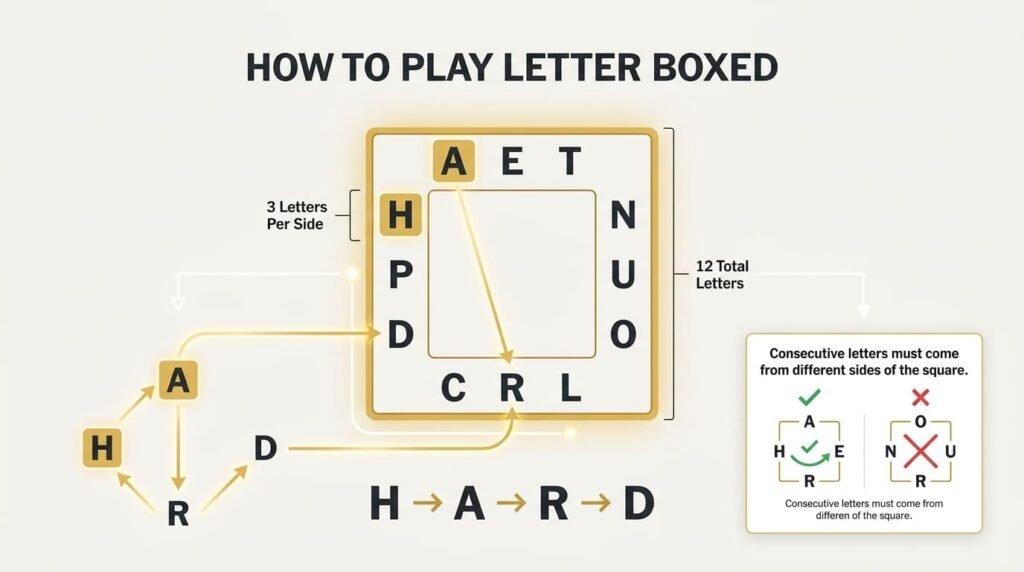
The board is essentially a square shape with four edges. Each edge has three letters, and no letter is ever used twice. In order to create a new word, each letter used after the initial letter must come from a different edge from its predecessor. Therefore, if the last letter was on the top edge, then the next letter has to be on one of the other edges and cannot come from the top edge.
It is this rule alone that makes the game a true exercise in planning as opposed to just a vocabulary test, since you need to plan according to the arrangement of the squares in addition to the words that you know.
Letter Boxed Game Rules: Complete Guide
Knowing these rules takes only two minutes. Not adhering to any one of these rules will result in rejection of words that you are sure of being valid.
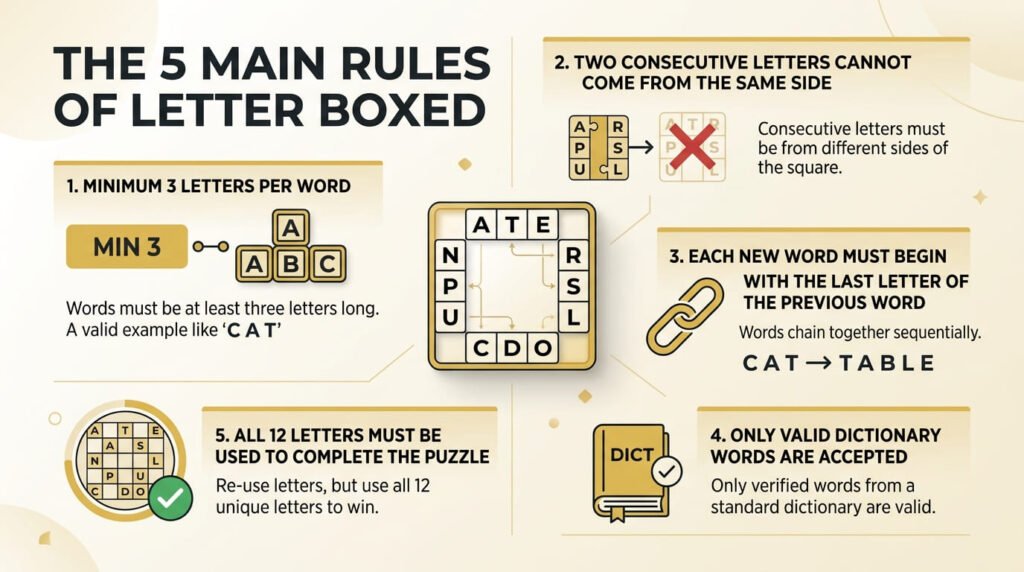
Rule 1: Minimum Number of Letters Per Word
Each word should have a minimum of three letters. No matter how correct they are, no two-letter words are ever accepted. These include words such as AT, ON, and IT.
Rejected: AT, ON, I.T Accepted: ATE, OAK, TON
Rule 2: The Same Side Rule
Two letters in a row in a word can never come from the same side of the square.
Rejected: SEE, when S and the first E are both on the upper edge. Accepted: STONE, where each letter in succession comes from different sides.
Rule 3: Word Linking
Each successive word must begin with the precise same letter that ends the preceding word.
Non-conformable link: GOLDEN to STONE; because GOLDEN ends with N but STONE begins with S . Conformable link: GOLDEN to NATURE; because GOLDEN ends with N and NATURE starts with N
Rule 4: Word Verification
English dictionary words only. Names, initials, slang, abbreviations, and compound words are all invalid. Valid forms include plural form, past tense form, and comparative form.
Invalid: LONDON, NASA, GONNA. Valid: GLASSES, WORKED, STRONGER
Rule 5: Total Coverage of All Twelve Letters
The game is not considered completed unless all the twelve letters have been included in any of your answers. The reuse of letters in other words is acceptable.
Typical Confusions of Rules
If a word that you are sure is spelled correctly continues to be rejected, consider these three factors, in order. Firstly, is there a pair of letters within the word that are found on the same side of the game board?. Secondly, is it a proper noun or an abbreviation that is not recognized by the dictionary? Lastly, does the word really begin with the same letter your last word ends with? The above three issues will solve almost all of your problems.
Walkthrough: Example of a Solution
The best way to get an idea of all the rules in one go is through solving an example on a sample game board.
Sample board:
| Side | Letters |
| Top | A, E, T |
| Right | N, U, O |
| Bottom | C, R, L |
| Left | D, P, H |
Solution to solve the problem:
- HARD: H (left) to A (top) to R (bottom) to D (left). Each letter moves to the other side of the triangle and therefore is a correct word.
- DANCE: D (left) to A (top) to N (right) to C (bottom) to E (top). This word begins with D, the last letter of the previous word HARD.
- ERUPT: E (top) to R (bottom) to U (right) to P (left) to T (top). This word begins with E, the last letter of the previous word DANCE, and also introduces new letters U and P.
- TOLD: T (top) to O (right) to L (bottom) to D (left). This word begins with T, the last letter of the previous word ERUPT, and introduces the remaining two letters O and L.
All twelve letters, namely, A, C, D, E, H, L, N, O, P, R, T, and U, have been used at least once in the above words.
Also note that ERUPT was a good option in the middle of this puzzle, in part because the letter T comes at the end of it and there are numerous common words starting with T. Just like with choosing the right ending letter, planning your first letter is as critical as memorizing words.
Good and Bad First Words
Your first word will define the whole path to solving the crossword puzzle, so it is better to spend some time thinking about which word to choose rather than taking the first available word that fits in the grid.
A good first word usually consists of five or more letters, ends on a letter that is used widely in the language (such as E, R, S, T, or N), and touches one letter on each side of the board when it is possible. Planets and Gardens would be good choices in such cases.
Poor opening word candidates include words that are short, end in an infrequently used letter like Q, X, Z, V, or J, and cluster most of their letters on one side of the board or two. While CAT would be a legally acceptable word, it doesn’t utilize much of the board and will make your second move difficult to play.
Take a quick look at what your first word ends in before you lock it down and ask yourself if the letter leaves you anywhere to go.
Playing All Around the Board
It’s always a good idea to consciously make an effort to use all four sides as early as your first or second letter, rather than simply playing side by side, as you go through the entire board. Those players who normally play the first two sides but leave the rest of their letters to be played on the two other sides will find themselves getting stuck on those sides where their letters were untouched. Looking around the board and thinking about how many letters are untouched on each side can help you figure out a way to play all around the board.
Use of Short Connectors
Not every word in your sequence will necessarily be long. You can use a short three- or four-letter word between two other long words as an effective connector that picks up one or two more letters. For instance, in a situation where all other letters except for the U and the P are exhausted, PUT is an excellent choice rather than trying to find a word containing both of them.
What Can Be Considered a Word?
There are certain conditions for a word to qualify as a word in the game. The word has to be made up of at least three letters, the word must obey the side rule throughout, the word must begin with the last letter of the preceding word, and the word must exist in the dictionary.
The Dictionary We Are Using
This site verifies all words against a comprehensive English dictionary specially compiled for word chain puzzles such as this one. As different Letter Boxed sites have different word dictionaries, it is natural for a word to be valid on one site but invalid on another, depending on the underlying dictionary.
Why is This Word Invalid
Run down the following checklist whenever a word is marked as invalid in a puzzle. Were two consecutive letters used from the same side? Does the word begin with the chaining letter? Is the word at least three letters long? Is it a legitimate word in a dictionary and not a proper noun or an abbreviation? Running down the above four checks will take around ten seconds.
Valid vs Invalid Word Examples
| Word | Status | Reason |
| STONE | Valid | Real word, at least three letters, no rule violations assuming the board allows it |
| IT | Invalid | Only two letters, below the minimum length |
| LONDON | Invalid | Proper noun, not accepted by the dictionary |
| GONNA | Invalid | Informal contraction, not a standard dictionary word |
| RUNNING | Valid | Real word, gerund forms are accepted |
| GLASSES | Valid | Real word, plurals are accepted |
| SEE | Often invalid | Frequently breaks the same side rule since the two E letters commonly sit on the same side |
| NASA | Invalid | Abbreviation, not accepted |
Difficulty levels of Letter Boxed: Easy, Medium, and Hard
The Easy level consists of board puzzles created out of letter combinations that have many, generous words which are valid, thus allowing new players to have space to discover without immediately being limited.
The default level is Medium; it offers enough variety to make it seem reasonable, yet at the same time it offers enough limitation such that a random strategy will not help at all.
The Hard level consists of puzzles that come from limited combinations of letters, sometimes even containing an unusual letter, which means that it is made for people who already know the side rule.
Playing on Desktop and Mobile
This version functions on all browsers and does not require any installation on both desktop and mobile devices.
When playing on desktop computers, players may choose to use their mouse in order to select letters in order to form a word. Most people do not have any problems doing this quickly due to their knowledge about the placement of letters.
On mobile and tablet, the tap targets are big enough that the letters on the edges of the square can be tapped easily even on small phone screens. The board resizes itself to fit in the screen view, and there is no need to download the mobile application separately, as the browser version works just as well on a phone as on a laptop.
Daily Puzzle VS Unlimited Mode
The format of the daily puzzle,e where all the people in the world receive the same board once in 24 hours, gives a shared common experience. Comparing your solution with that of your friend becomes easy, as you can look at the exact same letters.
Unlimited mode does away with this common experience in favor of complete freedom. Play as many boards as you can on the difficulty level that you choose at any time. Neither one is better than the other, but unlimited mode was made especially for those people who needed more practice than the daily puzzle could give them.
Letter Boxed Playing Tips
Strategy in this game does not come from knowing lots of words by heart. The key to the strategy is in learning how to analyze the board and how to see which letters will give you trouble in the future. You need to pick your words in such a way that this problem never occurs.
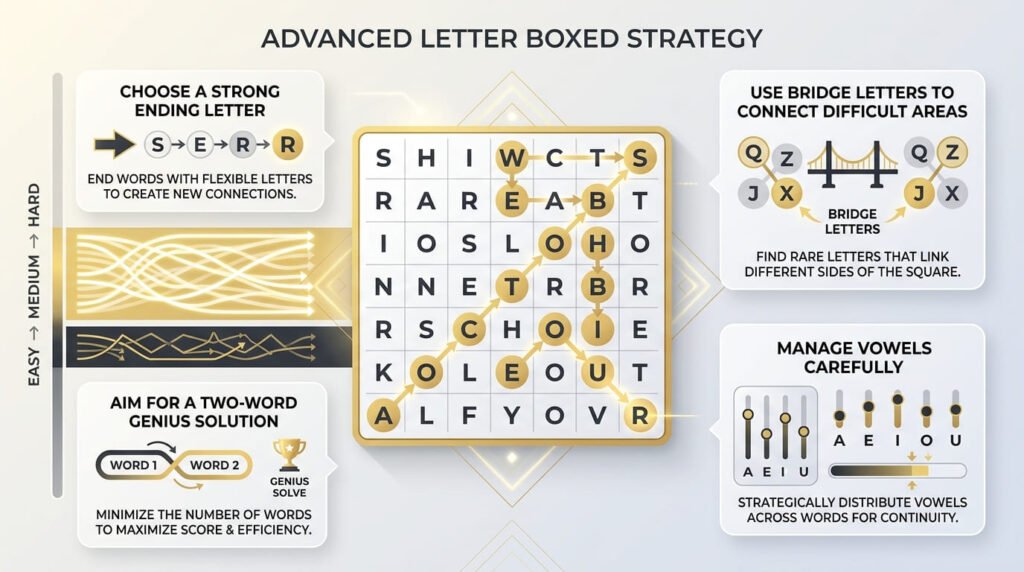
1. How to Pick Your Last Letter
It is important to know which letter will be used as the last letter of the word you play, because it influences all your subsequent choices. Frequent beginning letters like S, R, T, D, and N will allow you to choose among many different options when playing a new word. Uncommon beginning letters like Q, X, or Z will leave you with a very limited number of choices.
2. Bridge Letters
A bridge letter is a letter that allows you to connect two difficult areas on the board. Recognizing it and using it to your advantage can help you get the result you want within four words instead of having to use seven.
3. Vowel Management
Since each side of a board always includes both vowels and consonants, it becomes very hard to keep a record of the vowels not yet used. It becomes essential that you keep a mental record of the vowels still to be used in order to avoid a situation where you will have to struggle to complete the puzzle with one tough-to-reach vowel left.
4. Two Word Solution Strategy
A two-word solve, or a genius solve, is the most perfect possible solution. In order to get it, try to locate a long word that is eight letters long or more. The word should be able to cover almost all the letters on the board without breaking the same-side rule. If the last letter of the word is a common connecting letter, the other letters will make up the second word of your solution. However, not all boards have the possibility of a two-word solution. In such cases, you should change your objective to a three- or four-word solution after the first minute or so.
How to Avoid Getting in a Dead End Position
When a player finds himself or herself in a dead-end position, it means that the word he or she used just leaves the player in need of forming the next word out of a certain letter sequence, which is impossible. Thus, it is necessary for players to pause after choosing each letter and ask themselves whether there is at least one or two common words starting with the last letter of the chosen word using the available letters of the game.
As a practical example, one may use the case when a player’s board includes a Q on one of its sides, but does not have any U on other sides of the board – this means that the player should avoid forming the word ending in Q because there are very few words containing Q without U following it.
Common Errors Made by New Players
Beginners make common mistakes, which include using short words of three or four letters. This results in requiring six or more words. Also, not verifying the letter at the end before entering it, resulting in being stuck on a rare letter without any proper next step. Not realizing a same-side violation accidentally results in rejection of a certain word you know is right. Giving up on a board which could have been solved just after a few more steps.
What to Expect During Your First Week
The majority of players follow a somewhat standard progression during their first weeks of regular play.
On the first day or two, you will probably be solving almost all the boards in six or more words and also receiving quite some rejected words as you become familiar with the concept of the sides of the letter. This is perfectly fine and is not a sign of low vocabulary; it just shows that the same side rule requires practice.
By days three and four, double-checking your ending letter before submitting a word is likely to become second nature, rather than an extra effort you need to make, and average solves will have fallen to roughly five words.
By the end of the first week, regular players should be solving comfortably within four to five words and beginning to see bridge letters without looking for them. Solving in two words is still likely to be fairly uncommon at this point, but this is perfectly normal – and no cause for concern that something has gone wrong.
Vocabulary for Letter Boxed Specifics
Contrary to popular belief, it’s not the length or impressive nature of the words you learn that will be most helpful for this puzzle. These are short, common words that end on letters that show up often and that you can retrieve quickly while under the stress of solving. Learning a small number of go-to words that end in the letters S, R, T, D, N, and E, in a variety of lengths, is often more helpful than learning obscure words. Simply playing regularly is the best way to achieve this sort of retrieval vocabulary.
How long does it take to get good?
It varies greatly, as it is highly dependent on how frequently you play the game, as well as how much effort you put into analyzing your solves. However, according to most players, within two to three weeks of playing daily, one can feel a change in perspective on the gameplay, moving from random guessing to planning one's way through the board.
Achieving three- or four-word solves regularly takes some time to get there, but in order to get two-word genius solves, it would take much more effort, as sometimes it is simply impossible to achieve genius level on a specific board due to its combination of letters and not only the player's skills.
Letter Boxed Solver
How does the solver work?
The solver tool takes your specific board and runs a check in the dictionary in order to find out all possible words in the chain.
When to Use, and Not to Use It
A solver becomes a worthwhile learning tool after you have given a board a genuine effort to solve on your own. Studying how a solver can help you see the moves you should have made is among the quickest methods of picking up strategic patterns. Relying on a solver without making any effort whatsoever makes the puzzle into a lookup task and not what it is intended to be, namely a planning problem, with your personal skills failing to develop because of that. A good practice would be to work on a puzzle on your own for at least a few minutes before resorting to a solver.
How to Learn Using the Solver
The best possible way to learn using a solver is to solve the board manually first, despite its imperfections, and then use the solver to see how it would have solved it. Analyze in particular areas where you went off course and missed the most efficient way.
Was it a missed bridge letter? Was it ending an early word with a very uncommon letter that locked you in for later? Studying in this fashion, three to four solved boards will help more than reading an entire strategy guide because you will be learning from mistakes that you made, not tips.
Purposeful Exercises
There are certain things players can focus their attention on and improve upon.
For working with bridge letters, you should try pausing in between solving your first word and analyzing the board to determine which letter would be most difficult to get to.
In order to get practice with difficult letters, intentionally select hard mode games, which will contain such letters as Q, X, J, or Z, and practice planning the route of your solving starting from that letter, not leaving it to the very end.
In order to get practice with ending letter recognition, select a game where you will need to explicitly announce or write down the ending letter of each word before hitting the submit button and think whether it offers any good choices. The exercise is going to slow you down at first, but usually becomes an ingrained habit after several plays.
Letter Boxed vs Other NYT Games
Each NYT Games puzzle develops its own type of logical thinking, and recognizing these types will help you choose which game to play today.
| Letter Boxed | Wordle | Spelling Bee | Connections | |
| Core mechanic | Chain letters around a box into connected words using all twelve | Guess a five letter word in six tries | Make as many words as possible from seven letters, one mandatory | Sort sixteen words into four hidden category groups |
| Skill rewarded | Forward planning and spatial pattern recognition | Deduction and elimination | Vocabulary breadth | Lateral, categorical thinking |
| Replayability | High, since most boards allow multiple valid solve paths | Low, one correct answer per day | Medium, score based rather than pass or fail | Low, one correct grouping per day |
Vs Wordle
In Wordle, you are required to guess the hidden word, one letter at a time. Letter Boxed contains no hidden words. Instead, you make your own solution based on what you come up with. Most boards have more than one correct path to the solution.
Vs Spelling Bee
In Spelling Bee, you have seven letters to work with. You are expected to find the largest number of words possible, thus proving your spelling skills. In Letter Boxed, your task is quite the opposite. You have to cover all twelve letters using the smallest number of words.
Vs Connections
Connections is a puzzle that involves pattern recognition and sorting existing words by categories. Letter Boxed is a puzzle that requires you to come up with the words on your own to create your own chain of letters. It uses a completely different set of skills.
Vs Strands
Strands requires you to look for hidden words based on a theme in the grid. In Letter Boxed, there is no element of hidden words in the grid at all. The difficulty of the puzzle is provided only by the side rule and chain of letters.
Vs Crossword
The NYT Crossword is the game with the most vocabulary and trivia in the series, which tests players through clue answers. Letter Boxed requires players to have great vocabulary skills too, but the challenge in the game is due to the structure and rules.
Which NYT Word Game Should You Play?
If you prefer making a strategic move rather than making a guess within a time limit, then Letter Boxed is better than Wordle. If you have a rich vocabulary and love finding rare words, Spelling Bee might be right for you. If you like finding categories in the game, Connections is the one to play. If you have five to fifteen minutes and want to play a challenging puzzle game, then Letter Boxed is your best choice.
Is Letter Boxed Free?
This version of the game is completely free of charge and does not require any subscription.
The new and current version of the puzzle in The New York Times now requires an NYT Games Subscription to gain access, after NYT Games shifted to a subscription-based system for accessing their games. And if you've run into this roadblock and simply want to continue playing your game in your favorite format, then this site was made for that very purpose.
Letter Boxed Statistics and Skill Levels
Your score depends on the number of words needed to spell out all twelve letters. There are no scores, just words, and the fewer words, the better you are.
Skill Tier Table
| Words used | Result | Skill tier |
| 2 words | Genius solve | Master level |
| 3 words | Excellent | Expert level |
| 4 words | Good | Advanced level |
| 5 words | Solid | Intermediate level |
| 6 or more words | Valid win | Beginner level, still a full completion |
How Realistic Is an Improvement Target?
A reasonable target for most of the players would be the ability to solve the puzzles by using only six or even less than six letters in the first week and then reduce the number of words to a stable level of four to five words per board after one month of playing regularly, a few times a week.
Consistently solving the puzzle with three words is a very good intermediate or advanced target, which requires more time due to the necessity of understanding the letters used in bridge letter games. Solving the puzzles with two words is a very good goal to achieve occasionally, not always, since there are certain letter combinations which cannot be solved with two words regardless of the level of the player's skills of the player.
Frequent vs Uncommon Letters
Letters such as E, A, R, T, I, N, and S come across on most boards as they form combinations with a lot of possible words. Uncommon letters, such as Q, X, Z, and J, come across much less frequently but are the ones that make the puzzles extremely hard to solve since the possible words are limited.
Typical Solve Time by Experience Level
These figures reflect general patterns observed across casual play rather than a formal study, since no independent research currently measures Letter Boxed solve times specifically.
| Experience level | Typical solve time | Typical word count |
| First week of play | 4 to 8 minutes | 6 or more words |
| Regular player, several weeks in | 2 to 4 minutes | 4 to 5 words |
| Experienced player | 1 to 2 minutes | 3 to 4 words |
| Advanced player chasing genius solves | Under 1 minute on familiar boards | 2 to 3 words |
Why Should I Play Letter Boxed? The Actual Research Behind It
Crossword-like word puzzles such as Letter Boxed are much more than just an entertaining way of spending a few moments. There is real and verified research on why you should form a habit of solving puzzles, and it is important to know what these studies prove rather than just make general statements.
Healthy aging and cognitive reserve. A huge 2018 study conducted by the University of Exeter and King's College London, which was published in the International Journal of Geriatric Psychiatry, involved 19,000+ people aged between 50 and 93 via the PROTECT research platform and was funded by the Alzheimer's Society.
According to the study results, those people who played word and number puzzles more often had better results when taking part in cognitive tests assessing attention, reasoning and memory skills. The Alzheimer's Society Head of Research has called the discovery an important first step while noting that puzzling does not have proof of preventing dementia yet.
Adults with Mild Cognitive Impairment: The Functioning of their Memory. The research that was conducted by the team of scientists from Columbia University and Duke University in 2022 and published in NEJM Evidence involved the comparison of effects of crossword training and computerized cognitive games among 107 adults who had mild cognitive impairment.
The participants in the study who had the crossword training demonstrated better results on the main cognitive outcome measure not only after 12 weeks of training but also after 78 weeks of training in comparison to those who used computer games for training. However, neither of the studies has examined Letter Boxed because there is no specific clinical trial of this type of puzzle yet.
Word memory. Actively seeking out the right answer to a valid question in a real situation, which is precisely what the same-side rule makes you do, means actively recalling the answer from your memory rather than merely recognizing it in print. Active retrieval of this sort is generally agreed to have a more powerful effect on memory than passive reading in cognitive science.
Executive function and working memory. Thinking about the best path to take through the box, considering in advance where you would like to finish and why, utilizes the very executive functions and working memory you use when organizing your time or making a trip somewhere new.
To be honest, there are some websites in this area that cite specific studies that cannot be independently researched, such as a supposedly 2023 study in Frontiers in Psychology suggesting that word puzzles reduce cortisol levels, while building this page. If you encounter a citation like that somewhere else, treat it with healthy skepticism rather than credulity.
Who Is Letter Boxed For?
Students and Classrooms
An extremely relaxing way to introduce students to contextually rich new words on a regular basis. The nature of the game almost guarantees that you will find yourself forced to recall a word that you have learned but do not often use. Students preparing for vocabulary-intensive tests usually discover through the game that words they were supposed to have memorized actually pop up.
For Teachers
Teachers wanting a quick and easy warm-up task for their classroom will discover that the format can also serve as a form of vocabulary practice. One board can function either as a warm-up exercise that lasts about five minutes at the beginning of the lesson, as a group activity where students take turns suggesting the next word in a chain, or as a bonus task for those who finished other tasks earlier than the others.
Since there is no one single correct answer to the puzzle, the same board can be given to a whole class without any of the students being able to just copy someone else's solution.
Professionals
Compact and short enough to easily fit into a coffee break while offering the level of engagement needed to allow for a mental refresh before going back to work. The game itself calls for focus, which makes it a good choice for the purposes of resetting rather than scrolling through social media. Many professionals play it during breaks between meetings because it requires enough concentration to distract from work-related thoughts while not requiring the level of focus that a long task would.
Word Enthusiasts
For those who have completed both Wordle and Spelling Bee and are looking for a third word game challenge, this one is made for this exact purpose, and thanks to unlimited mode, there is always another board ready. Those who appreciate the strategic thinking of chess and Sudoku may find Letter Boxed particularly rewarding due to the importance of finding the right path instead of just knowing a lot of words.
Seniors and Lifelong Learners
A relaxed, fun method of keeping one’s linguistic abilities and patterns up to speed without having to put in too much effort because of the learning curve involved in other more complicated games. Adjusting the level of difficulty makes the puzzle suitable and easy to grow in line with the player. The Easy level in particular is especially created in such a way that even a novice at online puzzle games can play it with ease.
Is Letter Boxed Safe to Play Online?
The game itself does not present any danger of any kind. All possible dangers are from other websites using the same name to advertise intrusive ads, pop-ups, or misleading downloads. There are some simple practices that guarantee safety. Make sure that the website you are visiting uses the HTTPS prefix.
You should never download any file claiming to be a Letter Boxed app from an unknown source, since it only exists within the NYT Games app from reputable app stores. Close down any website that attempts automatic redirection. Never type in a password on an unknown puzzle website.
Glossary Letter Boxed
- Same side rule: The fundamental constraint, whereby no two letters within the word can both be picked from the same edge of the square.
- Chaining: The necessity that all subsequent words begin with the letter that your previous word ended in.
- Bridge letter: A letter which facilitates connections between two usually difficult areas of the board.
- Dead end: A point in your solving process, beyond which the remaining letters cannot be completed using any words.
- Complete coverage: The victory condition of having used each of the twelve letters at least once in any words.
- Genius solve: A solve performed in only two words, the best possible outcome on almost any board.
- Board: The square containing the twelve letters, three letters on each of its four sides, which defines one problem.
- Solve path: The unique series of words that you use in order to achieve complete coverage. Any number of solve paths may be possible on any particular board.
- Par: The unofficial measure of how many words a decent solve will take, three to five being average.
- Word Chain: the entire chain of connected words in one solve, joined from end to end by the chaining rule.
- Unlimited mode: a mode that creates a fresh new board at your request rather than allowing only one puzzle per day.
Accessibility
Word games should be truly playable by anyone, not only by users with flawless color perception and a mouse pointing to the desktop screen. This website is created with big, contrastive tap targets that will stay legible for the colorblind, and all the main actions like solving, erasing a letter, and sending your answer work well using a touchpad, keyboard, and screen reader navigation. Should you come across an accessibility problem on this website, please contact us through the Contact page.
Next We Are Planning to Create
Our website is developing, and there are several features we have planned. Printable puzzles to play offline – convenient for class or traveling use, or for anyone who likes to play using pen and paper. An Urdu language version of the game and main guides. A visual solver that displays a graph of the real connections between the letters on a board.
Frequently Asked Questions
Ready to Get Started?
Now just scroll back up, pick your level of difficulty, and launch the very first puzzle. No registration, no installation, no money spent needed.
Whether you've been here because you've been enjoying the official New York Times one and wanted additional training, stumbled upon a subscription barrier and sought an alternative that would be really free, or have never encountered any of these before, everything on this page has been prepared specifically for you to get started smoothly within a matter of minutes. If you plan to come back, please make sure to bookmark this page, since all the information above was prepared for you to use as a reference while solving subsequent puzzles.